

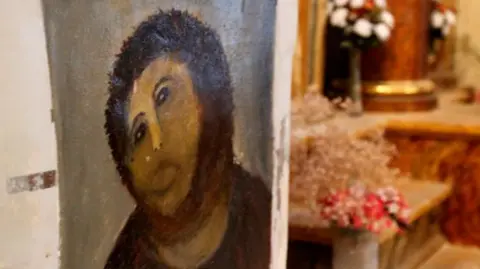
The elderly woman from Spain who achieved global fame for her infamous repair job on a valuable religious painting has passed away at the age of 94.
The woman, a resident of the town of Borja in northern Spain, became a global sensation thirteen years ago after she attempted to repaint a 100-year-old painting known as Ecce Homo housed within her local church.
Giménez's restoration effort spread across the internet and was dubbed "Potato Jesus", because the resulting depiction of Christ's head bearing a resemblance to a hairy monkey.
Local Announcement and Tribute
The nonagenarian's passing was announced by Borja's mayor, Eduardo Arilla, via an online statement, where he acknowledged her as a "passionate enthusiast of painting from a young age".
"Rest in peace Cecilia, we will always remember you," the mayor posted.
Arilla further referenced Giménez's "now-legendary restoration of Ecce Homo" in the summer of 2012, which "because of the poor state of conservation it was in, Cecilia, with the best intentions, decided to apply new paint over the original".
The Artwork's Background and the Now-Infamous Intervention
The Ecce Homo ("Behold the Man" in Latin) by nineteenth-century painter Elias Garcia Martinez had resided for over a century in the Santuario de la Misericordia close to Zaragoza.
At the time, Giménez, then 81, explained that parishioners had "traditionally fixed everything here", and that she had received permission from the parish priest to proceed.
She added at the time that anybody who entered the church would have observed she was painting over the existing artwork.
An Unexpected Tourist Boom
The aftermath of the restoration spawned the "Ecce Mono" internet phenomenon and saw the once quiet town of Borja quickly become a significant tourist destination.
The town, which had in the past seen only five thousand tourists per year, received over 40,000 tourists by 2013, and generated more than €50,000 for charity from the interest.
Currently, local authorities estimate that between 15,000 and 20,000 tourists travel to Borja every year to see the famous painting, which is now displayed behind a protective shield of glass.
Later Life and Local Support
Following the initial backlash, backed by the townspeople and others globally, Giménez went on to hold an exhibition of her paintings showcasing 28 of her personal paintings.
She was commended by Borja's mayor for her kind-hearted nature and decades of faithful service to the parish.
Ultimately, what began as a well-intentioned but unsuccessful act of restoration created an unlikely piece of pop culture and provided remarkable tourist revenue to a small Spanish town.


